Solar Smart
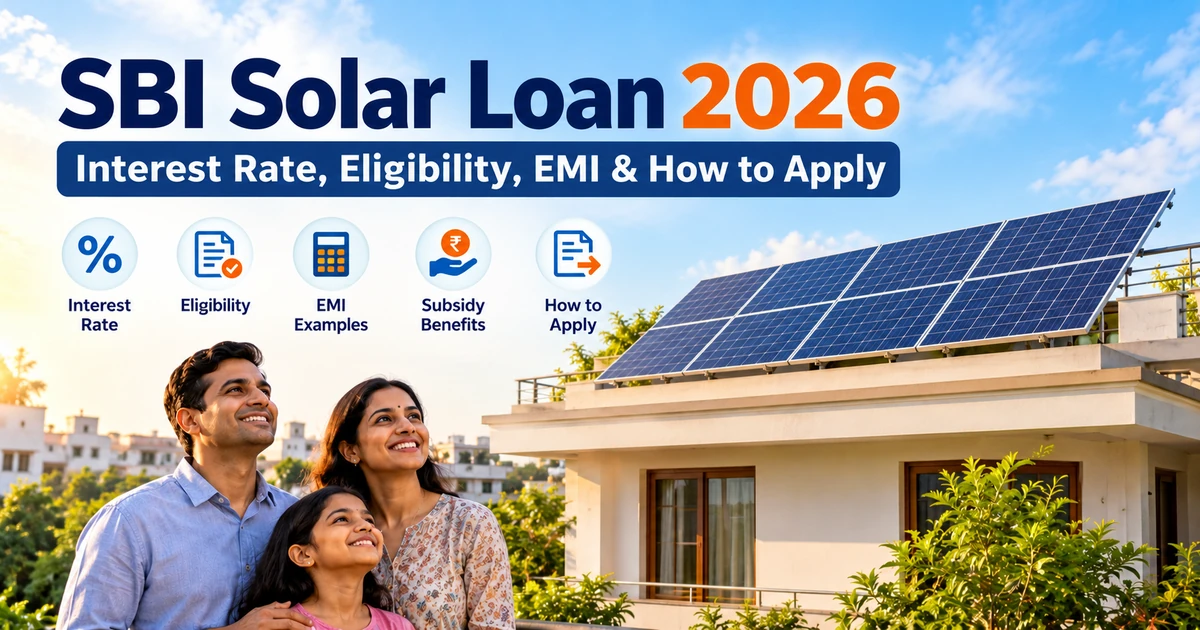
Although a rooftop solar system can reduce a household’s electricity purchases from the grid for many years, the installation requires an upfront investment. However, for many families, that upfront cost is the real obstacle because the government subsidy arrives only after installation. The SBI solar loan, officially called SBI Surya Ghar – Loan for Solar Roof Top, exists to bridge that gap.
Specifically, it is a floating-rate loan from State Bank of India for installing rooftop solar on a home where you have roof rights, linked to the PM Surya Ghar: Muft Bijli Yojana. In addition, SBI lends up to ₹6 lakh, asks you to contribute at least 10% of the project cost, and pays the money directly to your registered solar vendor. Once the government releases the central subsidy, it goes into your SBI loan account.
In this guide, you’ll learn about SBI’s current interest rates (revised on 15 October 2026), eligibility, required documents, EMI examples, subsidy benefits, and application steps through the PM Surya Ghar and Jan Samarth portals. Furthermore, every SBI rate and rule links to SBI’s own pages, while every subsidy rule links to the Ministry of New and Renewable Energy (MNRE) or another named official source.
Quick Answer: SBI Solar Loan at a Glance
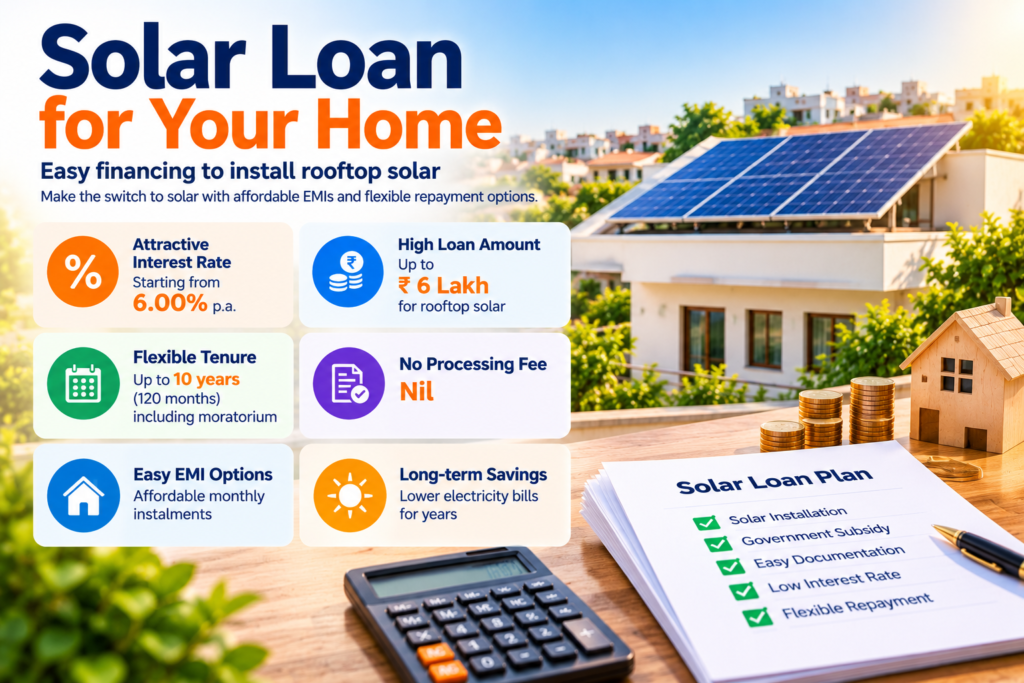
The SBI solar loan charges 6.00% p.a. for loans up to ₹2 lakh and 8.15% p.a. for loans above ₹2 lakh up to ₹6 lakh. Importantly, both rates are floating and linked to SBI’s External Benchmark Lending Rate (EBLR). According to the features table on SBI’s Surya Ghar loan page, these rates became effective on 15 October 2026. In addition, there is no processing fee and no prepayment penalty.
Key takeaways
- Maximum loan: ₹6 lakh, with no minimum. Also, the loan covers systems up to 10 kW.
- You also pay at least 10% of the project cost as margin.
- Up to ₹2 lakh: no minimum CIBIL score, no income proof, PAN optional.
- Above ₹2 lakh: in contrast, you need a CIBIL score of 650 or more, net annual income of ₹3 lakh or more, PAN and income proof.
- Repayment: up to 120 months, although that limit includes a 6-month moratorium.
- You register on the PM Surya Ghar portal first, then apply for the loan on Jan Samarth.
- SBI pays the vendor. Additionally, the central subsidy (up to ₹78,000 in general-category states and ₹85,800 in special-category states and UTs) goes into your SBI loan account. Under MNRE’s guidelines, moreover, any amount above your outstanding loan goes to your bank account.
SBI Surya Ghar loan features by loan slab
| Feature | Loan up to ₹2 lakh | Loan above ₹2 lakh to ₹6 lakh |
|---|---|---|
| Interest rate (from 15.10.2026) | 6.00% p.a., floating (EBLR − 2.15%) | 8.15% p.a., floating (EBLR + 0%) |
| Minimum CIBIL score | None prescribed (no defaults or write-offs) | 650 |
| Net annual income | No requirement | Minimum ₹3 lakh |
| PAN | Optional | Mandatory |
| Customer margin | Minimum 10% of project cost | Minimum 10% of project cost |
| Processing fee | Nil | Nil |
| Maximum tenure | 120 months, including 6-month moratorium | 120 months, including 6-month moratorium |
| Prepayment penalty | None | None |
| Security | Hypothecation of the financed assets | Hypothecation of the financed assets |
| Asset insurance | Optional per SBI’s FAQ and documents table; a features-table note says not mandatory for 1–3 kW | Mandatory per SBI’s FAQ and documents table, at customer’s cost; a features-table note makes it mandatory above 3 kW |
Source: SBI Surya Ghar – Loan for Solar Roof Top, features table, documents table and FAQs; page last updated 19 October 2026. SBI’s page links mandatory insurance to system size in one place and to loan size in another, so confirm which applies to you.
Table of Contents
- What Is the SBI Surya Ghar Loan?
- SBI Solar Loan Interest Rates in 2026
- SBI Solar Loan Eligibility
- SBI Solar Loan Documents Required
- SBI Solar Loan EMI Calculator and Examples
- SBI Solar Loan for 2kW, 3kW and 5kW Rooftop Solar Systems
- PM Surya Ghar Subsidy and the SBI Solar Loan
- How to Apply for SBI Solar Loan Online
- What Happens After SBI Solar Loan Approval?
- Common Reasons for SBI Solar Loan Delays or Rejection
- SBI Solar Loan vs Paying for Solar Yourself
- Important Things to Check Before Applying
- Frequently Asked Questions
- Conclusion: Is the SBI Solar Loan Right for You?
- How We Verified This Guide
What Is the SBI Surya Ghar Loan?
The SBI Surya Ghar Loan is a retail loan from State Bank of India for installing a rooftop solar system on a residential property. SBI offers it alongside PM Surya Ghar: Muft Bijli Yojana, the central government’s rooftop solar programme for households. According to SBI’s Surya Ghar loan page, you must first register every application on the national PM Surya Ghar portal and then apply for the loan through the Jan Samarth portal.
In general, SBI offers the loan to resident individuals who have rooftop rights and enough roof area for the system, an active electricity connection, and an SBI savings account. SBI also covers systems up to 10 kW and pays the loan directly to a vendor registered on the national portal.
The loan and the subsidy are two different things
People often talk about the loan and the subsidy as one benefit. However, they are separate, and different authorities decide each one.
- The loan is SBI’s money, repaid with interest. Therefore, SBI decides whether to approve it, how much to lend and at what rate.
- The subsidy (central financial assistance, or CFA) is government money for eligible installations. MNRE’s operational guidelines say the government releases it only when the DISCOM has inspected and approved the installation. They also confirm that a household can fund the system personally or through a loan and still qualify.
When you finance through SBI, the subsidy goes into your loan account and reduces the principal you owe. However, it does not reduce what you pay on day one: your 10% margin is still due before installation, and SBI lends against the project cost, not the post-subsidy price.
SBI Solar Loan Interest Rates in 2026
As of 23 October 2026, the SBI solar loan interest rate is 6.00% p.a. for loans up to ₹2 lakh and 8.15% p.a. for loans above ₹2 lakh up to ₹6 lakh. In addition, both rates are floating and took effect on 15 October 2026.
| Loan slab | Interest rate | Rate type | How SBI prices it | Effective date | Official source |
|---|---|---|---|---|---|
| Up to ₹2 lakh | 6.00% p.a. | Floating | EBLR − 2.15% | 15.10.2026 | SBI Surya Ghar loan page, features table |
| Above ₹2 lakh up to ₹6 lakh | 8.15% p.a. | Floating | EBLR + 0% | 15.10.2026 | SBI Surya Ghar loan page, features table |
Similarly, the same rates and effective date appear on the SBI Green version of the Surya Ghar loan page.
How SBI arrives at 6.00% and 8.15%
SBI builds the two rates on its EBLR, which it revised on 15 October 2026. In fact, you can check each step on SBI’s own pages:
| Component | Value from 15.10.2026 | Official source |
|---|---|---|
| RBI repo rate shown by SBI | 5.50% | SBI interest rates page |
| SBI spread over repo | 2.65% | Same SBI interest rates page |
| SBI EBLR | 8.15% (revised from 7.90%) | SBI External Benchmark based Lending Rate page |
| Surya Ghar rate, up to ₹2 lakh | 8.15% − 2.15% = 6.00% | SBI Surya Ghar loan page, features table |
| Surya Ghar rate, above ₹2 lakh | 8.15% + 0% = 8.15% | SBI Surya Ghar loan page, features table |
The 6.00% rate also equals the repo rate plus 0.50%. In other words, it matches the benchmark of repo rate plus 0.50% described in MNRE’s operational guidelines for systems up to 3 kW.
Why some SBI pages still show 5.75% and 7.90%
On 23 October 2026, two places on SBI’s website still showed 5.75% and 7.90%:
- FAQ 5 on SBI’s Surya Ghar loan page, which carries the label “As on date (15.12.2025)”.
- The PM Surya Ghar entry in the rate panel on SBI’s loan-schemes interest rate page, which carries no effective date.
In fact, the older figures fit SBI’s previous EBLR of 7.90% exactly: 7.90% − 2.15% = 5.75%, and 7.90% + 0% = 7.90%. By comparison, the newer figures carry an explicit effective date of 15 October 2026, match the revised EBLR, and appear in SBI’s product features table. This guide therefore uses 6.00% and 8.15% and treats the older numbers as out of date. Even so, check SBI’s product page on the day you apply. After all, only the rate in your sanction letter binds you.
How a floating interest rate affects your EMI
A floating rate moves with a benchmark. In this case, the loan follows SBI’s EBLR, which in turn tracks the RBI repo rate. When the EBLR changes, the rate on your loan changes from the reset date in your loan agreement. Then, depending on your terms, the bank may change your EMI or your remaining tenure.
A small change adds up over a long tenure. For example, in a standard 120-instalment calculation, a 0.25 percentage-point rise moves the EMI on ₹2 lakh at 6.00% from about ₹2,220 to ₹2,246, and the EMI on ₹6 lakh at 8.15% from about ₹7,327 to ₹7,407. Of course, rates can fall as well as rise. Still, the October 2026 revision was itself an increase of 0.25 percentage points.
SBI Solar Loan Eligibility
According to SBI’s Surya Ghar loan page, you can apply for the SBI Surya Ghar Loan if you meet these conditions:
| Condition | What SBI requires |
|---|---|
| Applicant | Resident individual, aged at least 18 |
| Upper age limit, single applicant | Up to 65 years; you must close the loan before you reach 70 |
| Upper age limit, with a co-borrower | Up to 75 years; repayment of up to 10 years including moratorium, and you must close the loan before the co-borrower turns 75 |
| Roof | Rooftop rights over the roof where the system will go, and enough roof area as mandated by MNRE |
| Electricity connection | A valid, active household connection |
| Earlier subsidy | You should not have availed a solar panel subsidy before |
| Bank account | An SBI savings account is mandatory; you can open one and then apply |
| Vendor | Disbursement goes directly to a vendor or EPC contractor registered on the national portal |
| System size | Up to 10 kW |
SBI solar loan CIBIL score requirement
| Loan amount | Minimum CIBIL score | What else SBI checks |
|---|---|---|
| Up to ₹2 lakh | No minimum prescribed | SBI does not consider customers with a default or write-off on their credit report |
| Above ₹2 lakh up to ₹6 lakh | 650 | Same default and write-off exclusion |
SBI’s FAQ also says new-to-credit customers, people with no credit history, are eligible. However, “no minimum score” does not mean SBI ignores your credit report. In fact, a past default or write-off can rule you out at any loan size.
Income requirement by loan slab
For loans up to ₹2 lakh, SBI’s features table says “No Requirement” for net annual income, and its documents table does not stipulate income proof.
For loans above ₹2 lakh, SBI’s features table says net annual income must be a minimum of ₹3 lakh, and FAQ 3 says ₹3 lakh and above. SBI’s required-documents table, however, reads “Max NAI is ₹3 Lakhs”. Two of the three statements describe a minimum, so this guide treats ₹3 lakh as a minimum. Confirm with your branch before applying.
As a result, ₹2 lakh is the most important threshold in the scheme. Crossing it raises the rate from 6.00% to 8.15% and also adds the CIBIL, income and PAN conditions. SBI’s FAQ and documents table also link mandatory asset insurance to loans above ₹2 lakh, while a note in its features table links insurance to systems above 3 kW.
SBI Solar Loan Documents Required
SBI’s document list depends on your loan amount. Specifically, here is what SBI’s Surya Ghar loan page asks for.
| Document | Loan up to ₹2 lakh | Loan above ₹2 lakh up to ₹6 lakh |
|---|---|---|
| KYC (identity and address proof) | Required. Existing SBI customers whose KYC is complete and unchanged may not need a fresh set | Required |
| PAN card | Not mandatory | Mandatory |
| Electricity bill | Copy listed in the features table; the documents table says a physical bill is not mandatory | Same |
| Income proof | Not stipulated | ITR or Form 16 for 2 years, salary slip or a 6-month salary statement, or pension slip / PPO |
| Vendor documents | Quotation or invoice, site feasibility report, vendor–customer agreement | Same |
| Asset insurance | Optional per SBI’s FAQ and documents table (features-table note: not mandatory for 1–3 kW systems) | Mandatory per SBI’s FAQ and documents table, paid by the customer (features-table note: mandatory above 3 kW) |
Practical checklist before you start
These steps are not SBI rules, but they prevent the most common hold-ups:
- To begin with, check that your name is spelt the same on Aadhaar, PAN, your bank account and the electricity bill. Also keep proof of any name change ready.
- Note your electricity consumer number from your latest bill. This matters because both portals ask for it.
- Use one mobile number and email address throughout, since both portals log you in with them.
- If the house is jointly owned or in a family member’s name, ask SBI before applying what proof of rooftop rights it needs.
- Finally, for loans above ₹2 lakh, keep two years of ITR or Form 16 ready as PDFs.
SBI Solar Loan EMI Calculator and Examples
Your EMI depends on three numbers: the loan amount, the interest rate and the number of monthly instalments. In general, banks use the standard reducing-balance formula:
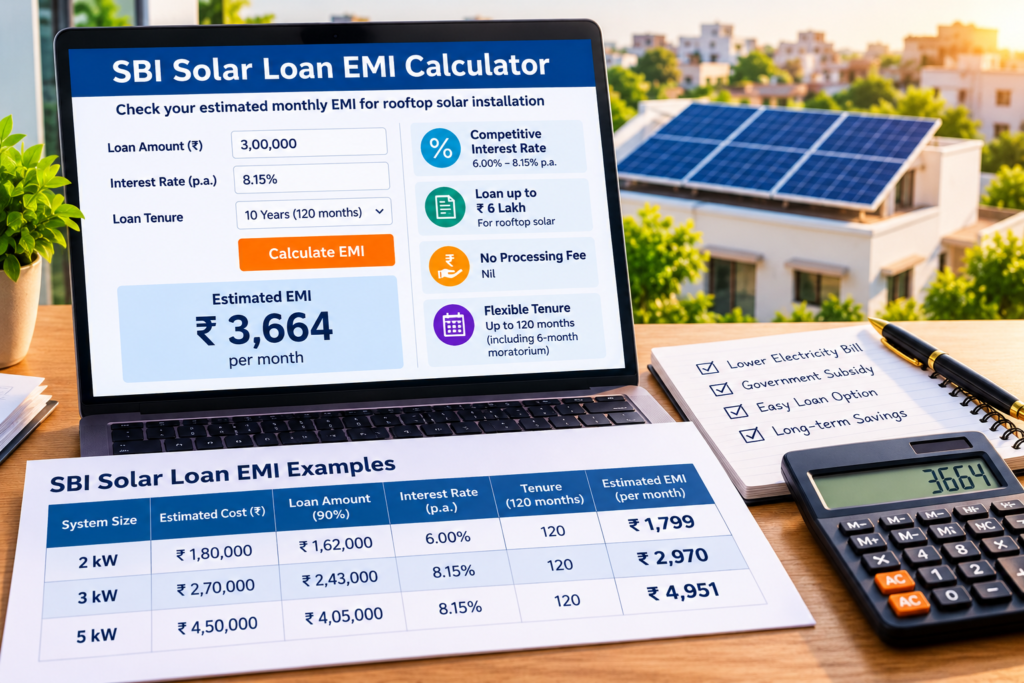
EMI = P × r × (1 + r)^n ÷ [(1 + r)^n − 1]
Here P is the loan amount, r is the monthly interest rate (annual rate ÷ 12 ÷ 100), and n is the number of EMIs.
How SBI’s tenure and moratorium affect the numbers
SBI’s maximum tenure is 120 months, and SBI’s Surya Ghar loan page says this includes a 6-month moratorium that starts from the date of disbursement. A loan that uses the full tenure would therefore have at most 114 EMIs, not 120.
SBI’s page does not say whether it collects interest during the moratorium, adds it to the loan, or handles it in some other way. So this guide does not guess. Instead, it shows three standard calculations. However, none of them is an SBI repayment schedule.
- 60 EMIs: a standard 5-year calculation.
- 120 EMIs: the figure most online EMI calculators give for “10 years”. It is a hypothetical, because SBI’s 120 months include the moratorium.
- 114 EMIs: the same loan repaid over the months left after a 6-month moratorium, assuming the principal stays unchanged when EMIs start. It also leaves out any interest for the moratorium period.
EMI examples: 60 EMIs (hypothetical)
| Loan amount | Annual rate (SBI slab, from 15.10.2026) | EMIs | Approx. monthly EMI | Total interest | Total repayment |
|---|---|---|---|---|---|
| ₹1,00,000 | 6.00% | 60 | ₹1,933 | ₹15,997 | ₹1,15,997 |
| ₹2,00,000 | 6.00% | 60 | ₹3,867 | ₹31,994 | ₹2,31,994 |
| ₹3,00,000 | 8.15% | 60 | ₹6,104 | ₹66,269 | ₹3,66,269 |
| ₹4,00,000 | 8.15% | 60 | ₹8,139 | ₹88,358 | ₹4,88,358 |
| ₹6,00,000 | 8.15% | 60 | ₹12,209 | ₹1,32,537 | ₹7,32,537 |
If SBI’s moratorium also applies within a 5-year tenure, there would be fewer than 60 EMIs and each would be higher.
EMI examples: 120 EMIs (hypothetical, standard calculator)
| Loan amount | Annual rate | EMIs | Approx. monthly EMI | Total interest | Total repayment |
|---|---|---|---|---|---|
| ₹1,00,000 | 6.00% | 120 | ₹1,110 | ₹33,225 | ₹1,33,225 |
| ₹2,00,000 | 6.00% | 120 | ₹2,220 | ₹66,449 | ₹2,66,449 |
| ₹3,00,000 | 8.15% | 120 | ₹3,664 | ₹1,39,638 | ₹4,39,638 |
| ₹4,00,000 | 8.15% | 120 | ₹4,885 | ₹1,86,184 | ₹5,86,184 |
| ₹6,00,000 | 8.15% | 120 | ₹7,327 | ₹2,79,276 | ₹8,79,276 |
EMI examples: 114 EMIs after a 6-month moratorium (principal unchanged)
| Loan amount | Annual rate | EMIs | Approx. monthly EMI | Total interest on the EMIs | Total of the EMIs | Six months’ interest at the slab rate (simple, for scale) |
|---|---|---|---|---|---|---|
| ₹1,00,000 | 6.00% | 114 | ₹1,153 | ₹31,436 | ₹1,31,436 | ₹3,000 |
| ₹2,00,000 | 6.00% | 114 | ₹2,306 | ₹62,872 | ₹2,62,872 | ₹6,000 |
| ₹3,00,000 | 8.15% | 114 | ₹3,789 | ₹1,31,945 | ₹4,31,945 | ₹12,225 |
| ₹4,00,000 | 8.15% | 114 | ₹5,052 | ₹1,75,926 | ₹5,75,926 | ₹16,300 |
| ₹6,00,000 | 8.15% | 114 | ₹7,578 | ₹2,63,890 | ₹8,63,890 | ₹24,450 |
The last column shows only how much interest six months represents on each loan. In other words, it is not a statement of what SBI charges. Therefore, ask SBI how it treats moratorium interest: whether you pay it during the moratorium, whether SBI adds it to the loan, or something else. Your EMI and total cost depend on that answer, so it is worth asking early.
Assumptions behind all three tables
- The tables use SBI’s slab rates effective 15 October 2026 and hold them constant for the whole period. In reality, as floating rates, they will change.
- The tables include no subsidy credit. The subsidy reduces your principal later (see the next section).
- We round EMIs to the nearest rupee. We calculate totals from unrounded EMIs, so they may differ from EMI × instalments by up to about ₹50.
These are illustrations, not SBI quotations. Only your sanction letter and repayment schedule are binding, so treat these figures as estimates.
How tenure changes affordability and total interest
Stretching a loan from 60 to 120 EMIs cuts the EMI by roughly 40%, but it about doubles the interest you pay. On ₹2 lakh at 6.00%, the EMI falls from ₹3,867 to ₹2,220, while total interest rises from ₹31,994 to ₹66,449. With 114 EMIs after a moratorium, the EMI is about 3–4% higher than the 120-EMI figure.
SBI charges no prepayment penalty, so a longer tenure with voluntary part-payments is an option. However, that only saves money if you actually make the extra payments.
The ₹2 lakh threshold: how much is rate, how much is principal?
The rate jumps from 6.00% to 8.15% the moment a loan goes above ₹2 lakh. When you compare a loan just above that line with one at ₹2 lakh, two things change at once: the rate and the amount borrowed. The table below therefore separates them, using the standard 120-EMI calculation.
| Comparison | Extra interest in total | Due to the higher rate | Due to the extra principal |
|---|---|---|---|
| ₹2,10,000 at 8.15% vs ₹2,00,000 at 6.00% | ₹31,297 | ₹26,643 | ₹4,655 |
| ₹2,70,000 at 8.15% vs ₹2,00,000 at 6.00% | ₹59,225 | ₹26,643 | ₹32,582 |
How the split works. First, the rate effect: ₹2,00,000 at 8.15% would carry about ₹93,092 in interest, compared to ₹66,449 at 6.00%, a difference of ₹26,643. This is a reference figure only, since SBI does not lend ₹2 lakh at 8.15%. Secondly, the principal effect: the interest on the extra amount borrowed at 8.15%. Rounded figures may differ by ₹1.
Two lessons follow. First of all, just above the threshold, about 85% of the extra cost comes from the higher rate. In this example, therefore, paying ₹10,000 more as margin to stay at ₹2 lakh would avoid about ₹31,300 of interest. Secondly, well above the threshold, more than half the difference comes simply from borrowing more. Remember, however, that a larger margin is cash you no longer have for other needs.
SBI Solar Loan for 2kW, 3kW and 5kW Rooftop Solar Systems
The scenarios below show how the pieces fit together for three common home system sizes. The installation prices are assumptions for illustration only. In other words, they are not official market rates and not Solar Smart quotations.
Actual cost depends on your roof type and structure height, panel and inverter brands, the domestically manufactured (DCR) modules the subsidy requires, cable runs, your state, and DISCOM charges for the net meter. For that reason, get an itemised quotation for your own home.
| Item | 2 kW | 3 kW | 5 kW |
|---|---|---|---|
| Assumed installation price | ₹1,40,000 | ₹1,90,000 | ₹3,00,000 |
| Your minimum 10% margin | ₹14,000 | ₹19,000 | ₹30,000 |
| Loan amount (90% of cost) | ₹1,26,000 | ₹1,71,000 | ₹2,70,000 |
| SBI rate slab (from 15.10.2026) | 6.00% | 6.00% | 8.15% |
| EMI, 120 EMIs (hypothetical, before subsidy) | ₹1,399 | ₹1,898 | ₹3,297 |
| EMI, 114 EMIs after moratorium (principal unchanged, before subsidy) | ₹1,453 | ₹1,972 | ₹3,410 |
| Potential central subsidy, general-category states (not guaranteed) | ₹60,000 | ₹78,000 | ₹78,000 (capped) |
| Subsidy as a share of the loan | 47.6% | 45.6% | 28.9% |
| Loan principal left for you to repay after the subsidy credit | ₹66,000 | ₹93,000 | ₹1,92,000 |
The last row is principal only. The interest you pay on top depends on when the subsidy reaches your loan account and how SBI adjusts the loan afterwards, which the next subsection explains. Also note that asset insurance is mandatory for the 5 kW system under a note in SBI’s features table, which applies it to systems above 3 kW.
How the subsidy credit changes your loan: a worked example
The subsidy does not arrive on day one. Instead, under MNRE’s operational guidelines, the government releases it only after installation, DISCOM inspection and approval, and the consumer’s claim on the portal. When it reaches your SBI loan account, it cuts the outstanding principal by the subsidy amount.
However, SBI does not publish what happens next. For instance, the bank could keep your EMI the same and shorten the loan, or keep the end date and lower your EMI. The example shows both, so you can see why the question matters.
Assumptions, chosen only to show the mechanics: a 3 kW loan of ₹1,71,000 at 6.00%, a standard schedule of 120 EMIs of ₹1,898 (moratorium ignored), and the ₹78,000 subsidy credited just after the 12th EMI. A different timing would, of course, give different figures.
| Item | No subsidy | Subsidy credited, EMI kept the same | Subsidy credited, end date kept the same |
|---|---|---|---|
| Balance after 12 EMIs | ₹1,58,128 | ₹1,58,128 | ₹1,58,128 |
| Balance just after the subsidy credit | — | ₹80,128 | ₹80,128 |
| EMI after the credit | ₹1,898 | ₹1,898 | about ₹962 |
| Total number of EMIs (approx.) | 120 | about 60 | 120 |
| Total interest paid (approx.) | ₹56,814 | about ₹20,000 | about ₹33,700 |
Three points stand out. First, the earlier the subsidy arrives, the more interest it saves. Second, keeping the EMI unchanged saves more interest than lowering it, because the balance falls faster. Third, MNRE’s guidelines say that if the subsidy is larger than your outstanding loan, the excess goes to your bank account. Therefore, ask SBI which adjustment it will apply, and whether you can choose.
What the 5 kW scenario shows
At ₹2,70,000, the 5 kW loan falls into the higher slab. As a result, it brings the 650 CIBIL requirement, the ₹3 lakh income condition, and PAN and income proof.
An alternative is to pay a larger margin of ₹1,00,000 and borrow ₹2,00,000 at 6.00%. In the standard 120-EMI calculation, that loan carries about ₹66,449 in interest, compared to about ₹1,25,674 on ₹2,70,000 at 8.15%. Of the ₹59,225 difference, about ₹26,643 comes from the lower rate and about ₹32,582 from borrowing ₹70,000 less. The alternative also needs ₹70,000 more upfront. Finally, note that the central subsidy stays at ₹78,000 in general-category states whether you install 3 kW or 5 kW.
PM Surya Ghar Subsidy and the SBI Solar Loan
Under PM Surya Ghar: Muft Bijli Yojana, households receive central financial assistance (CFA) of ₹30,000 per kW for the first 2 kW and ₹18,000 for one additional kW, up to 3 kW. There is no CFA beyond 3 kW, so the maximum is ₹78,000. You will find this in MNRE’s operational guidelines for CFA to residential consumers, and the same amounts also appear on SBI’s Surya Ghar loan page.
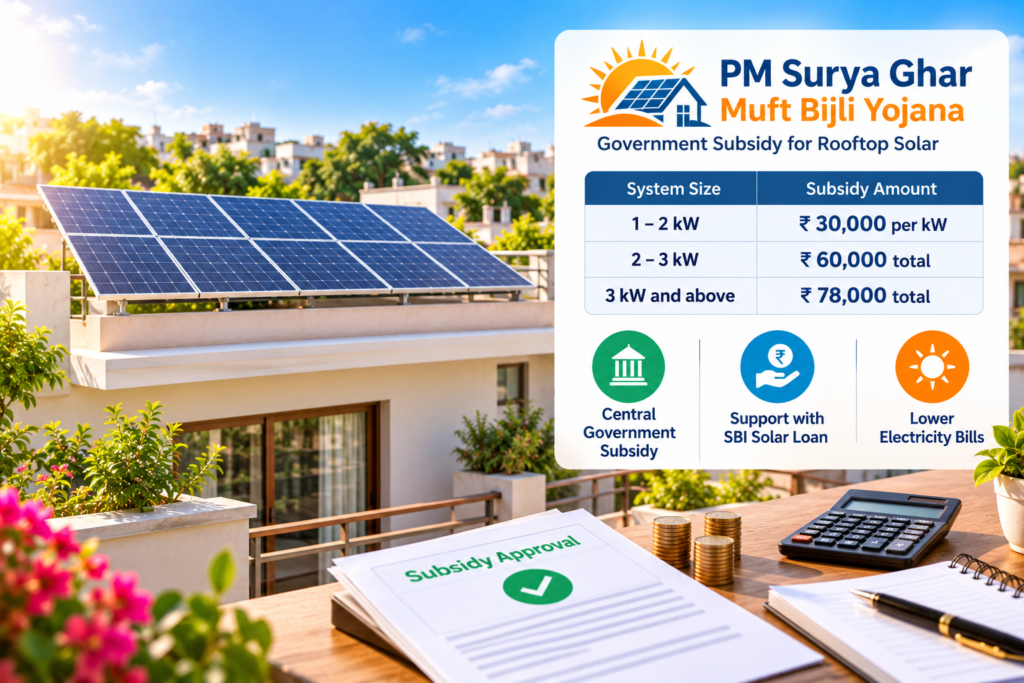
| System capacity | Central subsidy (general category) | Central subsidy (special category states and UTs) |
|---|---|---|
| 1 kW | ₹30,000 | ₹33,000 |
| 2 kW | ₹60,000 | ₹66,000 |
| 3 kW and above | ₹78,000 (maximum) | ₹85,800 (maximum) |
MNRE’s guidelines list the special category states and UTs as Uttarakhand, Himachal Pradesh, Jammu & Kashmir, Ladakh, the North Eastern states including Sikkim, the Andaman & Nicobar Islands and Lakshadweep. However, the guideline document opened for this article dates from 2024. MNRE has since issued a clarification notice, so check current figures on the PM Surya Ghar portal before you decide.
The government’s suggested system size depends on your average monthly electricity use, according to the Press Information Bureau’s scheme backgrounder:
| Average monthly consumption | Suggested capacity | Subsidy support |
|---|---|---|
| 0–150 units | 1–2 kW | ₹30,000 to ₹60,000 |
| 150–300 units | 2–3 kW | ₹60,000 to ₹78,000 |
| Above 300 units | Above 3 kW | ₹78,000 |
How the subsidy works when you take an SBI loan
- It is not an upfront discount. You pay your margin and SBI pays the vendor before the government processes the subsidy. In other words, the subsidy comes only after installation, net metering, DISCOM inspection and approval.
- It goes into your loan account. SBI says the subsidy must go to the customer’s loan account only, and you quote your loan account number when you claim it. MNRE’s guidelines say the same and also add that any amount above the outstanding loan goes to your bank account.
- You still have to meet the eligibility rules. MNRE requires a vendor registered on the national portal and modules made in India from Indian-made cells. MNRE also requires a DISCOM physical inspection, and a system receives CFA only once. The scheme also requires a valid electricity connection and no earlier solar subsidy, according to the PIB backgrounder.
- Loan and subsidy are separate decisions. SBI decides the loan. In contrast, government authorities decide the subsidy. So a sanctioned loan does not guarantee the subsidy, and the subsidy does not guarantee a loan.
- Timing can vary. For example, MNRE’s 2024 guidelines say the government processes CFA within 15 days of DISCOM approval. The PIB backgrounder pairs submitting bank details with receiving the subsidy within 30 days, and SBI’s journey guide says the subsidy reaches your loan account once the Government of India releases it. Therefore, treat any timeline as indicative.
- Maintenance is part of the deal. In addition, MNRE requires registered vendors to provide free comprehensive maintenance for 5 years from commissioning, which covers half of a 10-year loan.
State top-up subsidies
Some states also offer their own top-up subsidy on top of the central amount. Check with your state renewable energy agency or DISCOM, because these schemes vary and change.
How to Apply for SBI Solar Loan Online
To apply for the SBI solar loan, you first register your rooftop solar application on the PM Surya Ghar portal, then apply for the loan on the Jan Samarth portal. The steps below are based on SBI’s customer journey guide, which SBI calls indicative. They also draw on SBI’s Surya Ghar loan page and MNRE’s operational guidelines. However, portal screens can change.
Stage 1: Register on the PM Surya Ghar portal
- To begin with, register on the PM Surya Ghar portal. Go to the PM Surya Ghar national portal and enter your state, district, electricity distribution company, electricity consumer number, mobile number and email address.
- Then log in and submit your rooftop solar application. Log in again with your registered mobile number. Where applicable, your DISCOM gives feasibility approval, and the portal generates an application ID.
- After that, choose a registered vendor and get a quotation. The installer must appear on the national portal as a registered vendor. Agree the system size, equipment and price in writing. SBI needs the vendor’s quotation or invoice, a site feasibility report and a vendor–customer agreement.
Stage 2: Apply for the loan on Jan Samarth
- Then start the loan application on Jan Samarth. Go to the Jan Samarth portal, log in with your registered mobile number or email, and choose the loan from SBI.
- Link your PM Surya Ghar application. When asked, enter the application ID from the PM Surya Ghar portal, your DISCOM consumer ID and your mobile number.
- Enter your details. Then submit basic personal details, financial details, vendor details and bank details.
- Receive in-principle approval. After that, Jan Samarth generates a digital in-principle approval letter. However, this is not a final sanction.
- SBI processing and sanction. Your application then reaches SBI for processing. SBI’s guide says the bank sanctions the loan only if it clears processing; expect the bank to check your documents and eligibility and to complete documentation with you.
Stage 3: Disbursement, installation and DISCOM approval
- Disbursement to the vendor. SBI’s product page says it disburses the loan amount plus your margin directly to the registered vendor once all the feasibility reports MNRE requires are in place. In addition, SBI’s journey guide says SBI remits 70% to the vendor after documentation if it sanctions the loan. SBI does not publish when it pays the rest, or how it collects your margin, so ask your branch.
- Installation and net meter application. The registered vendor then installs the system, and you apply for a net meter.
- DISCOM inspection and commissioning. Subsequently, the DISCOM installs the net meter, physically inspects the system and records its approval and commissioning on the portal.
Stage 4: Claim the subsidy
- Claim the subsidy against your loan account. SBI’s guide asks you to submit bank account details and a cancelled cheque on the PM Surya Ghar portal. Quote your SBI loan account number, because SBI requires the subsidy to go to the loan account, not to your savings account. Similarly, MNRE’s guidelines describe this step as redeeming an e-token for the subsidy on the portal.
- Subsidy credit. Once the Government of India releases the subsidy, it goes into your SBI loan account.
You can also start from the “Apply Now” link on SBI’s Surya Ghar page, which takes you to the PM Surya Ghar portal. In fact, SBI says the loan is available through both a self-sourced online journey and an assisted journey.
What Happens After SBI Solar Loan Approval?
Loan approval happens in stages, and sanction and disbursement are not the same event. Here is the usual order once Jan Samarth issues in-principle approval:
- Sanction: first of all, SBI completes its checks and sanctions the loan. Then read the sanction letter for the rate, tenure, EMI, moratorium terms and reset terms.
- Documentation: after that, you sign the loan documents. SBI lists hypothecation of the financed assets as the security.
- First disbursement: SBI pays the vendor directly, not you. Its journey guide mentions 70% at this point.
- Installation: the vendor then installs the system. You also arrange insurance where SBI makes it mandatory.
- Net metering and commissioning: subsequently, the DISCOM installs the net meter, inspects the system and approves it.
- Moratorium and repayment: SBI’s moratorium runs for 6 months from disbursement. Regular EMIs follow afterwards; check your sanction letter for the start date and how SBI handles moratorium interest.
- Subsidy credit: finally, the subsidy goes into your loan account and reduces the principal. SBI does not publish whether it then lowers your EMI or shortens your tenure.
Keep copies of the sanction letter, repayment schedule, vendor invoice, commissioning record and portal acknowledgements. Also check your loan statement for the subsidy credit, and ask SBI in writing how it has adjusted your loan.
Common Reasons for SBI Solar Loan Delays or Rejection
Some reasons come straight from SBI’s eligibility rules. Others, however, are practical problems that commonly slow paperwork-heavy applications.
Official eligibility reasons (stated on SBI’s Surya Ghar loan page)
- A credit score below 650 for loans above ₹2 lakh.
- A default or write-off on your credit report, at any loan size.
- Net annual income below ₹3 lakh for loans above ₹2 lakh.
- Age outside SBI’s limits, or a repayment period that would run past them.
- No rooftop rights over the roof, or not enough roof area.
- A vendor missing from the national portal’s list of registered vendors.
- A solar subsidy already availed in the past.
Practical reasons (general experience, not SBI rules)
- Name or address mismatches across Aadhaar, PAN, bank account and electricity bill.
- An electricity connection still in a previous owner’s or late family member’s name.
- Jointly owned or rented property where rooftop rights are not clearly documented.
- Missing vendor documents, especially the site feasibility report.
- Typing errors in the consumer number or application ID across the two portals.
- Pending DISCOM feasibility approval.
- Incomplete KYC in an existing SBI account, or a changed mobile number.
If SBI declines your application, ask the branch for the reason before you reapply. You can fix many practical issues, so you can often resubmit the application.
SBI Solar Loan vs Paying for Solar Yourself
An SBI solar loan lets you install rooftop solar with as little as 10% of the cost upfront, but you pay interest. Paying in full avoids interest, but ties up your savings. In short, neither is right for every household.
| Factor | SBI solar loan | Paying yourself |
|---|---|---|
| Upfront cash | Minimum 10% of project cost | Full project cost |
| Interest cost | Yes; e.g. about ₹66,449 on ₹2 lakh at 6.00% in a standard 120-EMI calculation | None, though the savings you spend no longer earn returns |
| Monthly commitment | EMIs within a maximum 120-month tenure | None |
| Rate risk | EMI or tenure can change when SBI’s EBLR changes | None |
| Liquidity | Savings stay available for emergencies | Savings are used up |
| Central subsidy | Eligible if you meet scheme conditions; goes to your SBI loan account | Eligible if you meet scheme conditions; goes to your bank account |
| Paperwork | PM Surya Ghar portal, Jan Samarth and bank documentation | PM Surya Ghar portal and DISCOM process |
| Early closure | No prepayment penalty | Not applicable |
A simple test: compare the loan rate with what your savings earn after tax. If your savings earn less than the loan costs, paying yourself is cheaper in pure interest terms. Keeping an emergency fund intact can still make borrowing the more comfortable choice.
Important Things to Check Before Applying
Run through this list before you register on either portal:
- Affordability: Your EMI should fit your budget even if the floating rate rises.
- Consumption and system size: Match capacity to your actual monthly units, rather than just the maximum subsidy. For instance, the Solar Smart solar savings calculator gives a first estimate.
- Itemised quotation: Panel make, model and wattage; DCR status; inverter; mounting structure; cabling; net meter charges; warranty and maintenance terms. Also, our guide to the best solar panel technology for home explains the panel options.
- Vendor credentials: Confirm the vendor appears as registered on the PM Surya Ghar portal for your DISCOM area, and that its agreement includes the 5 years of free maintenance MNRE requires. In addition, see how to choose the right solar installation company for other questions to ask.
- System type: The PM Surya Ghar process described here includes net metering with your DISCOM, which applies to grid-connected systems. Our comparison of on-grid and off-grid solar systems explains the difference.
- Rate slab: Know whether your loan is up to ₹2 lakh or above, and also what the higher slab adds.
- Charges: The processing fee is nil, but ask about insurance cost and any other charges in your sanction letter.
- Roof suitability: Shadow-free area, structural condition and documents proving rooftop rights.
- Subsidy conditions: No earlier solar subsidy on the connection, a registered vendor and DCR modules.
- Questions for SBI: Disbursement schedule, how SBI collects your margin, treatment of moratorium interest, and whether EMI or tenure changes after the subsidy credit.
- Realistic savings: Solar reduces the units you buy, but fixed charges and other bill components usually remain. Read why your electricity bill may not be zero after installing solar.
Frequently Asked Questions
What is the latest SBI solar loan interest rate?
From 15 October 2026, SBI charges 6.00% p.a. on Surya Ghar loans up to ₹2 lakh and 8.15% p.a. on loans above ₹2 lakh up to ₹6 lakh, according to its product features table. Both rates are floating and linked to SBI’s EBLR, so they can change. SBI’s FAQ and one rate panel still show 5.75% and 7.90%; those figures match SBI’s pre-revision EBLR.
What is the maximum loan amount under the SBI Surya Ghar scheme?
The maximum SBI solar loan is ₹6 lakh, and SBI sets no minimum amount. In addition, the loan covers rooftop systems up to 10 kW. You must contribute at least 10% of the project cost yourself, so the loan can cover up to 90% of the cost, subject to the ₹6 lakh cap.
What is the minimum CIBIL score for an SBI solar loan?
For loans up to ₹2 lakh, SBI prescribes no minimum CIBIL score. For loans above ₹2 lakh, however, the minimum is 650. At any loan size, SBI does not consider applicants with a default or write-off on their credit report. SBI also says new-to-credit applicants with no credit history are eligible.
Can I get an SBI solar loan without a salary slip?
Yes, for loans up to ₹2 lakh. SBI stipulates no income proof in that slab; you need KYC, electricity bill details and the vendor’s documents. For loans above ₹2 lakh, however, you need income proof showing net annual income of at least ₹3 lakh. For example, SBI lists salary slips or statements, two years of Form 16 or ITR, or pension documents.
Does the SBI solar loan need collateral?
SBI lists “Hypothecation of Assets” as the security for this loan, meaning the financed solar system itself. Its product page does not ask for a property mortgage or other collateral. SBI mentions a co-borrower in connection with the higher age limit of 75. Confirm the security terms in your sanction letter before signing.
What is the EMI for a 3kW solar system with an SBI loan?
It depends on your loan amount. For example, if a 3 kW system cost ₹1,90,000 and you paid a 10% margin, you would borrow ₹1,71,000 at 6.00%. In that case, a standard 120-EMI calculation gives about ₹1,898 a month. With 114 EMIs after the 6-month moratorium and the principal unchanged, it is about ₹1,972. SBI does not publish how it treats moratorium interest, so your actual EMI may differ.
What is the repayment tenure of the SBI solar loan?
The maximum tenure is 120 months, or 10 years, and SBI says this includes a 6-month moratorium starting from disbursement. SBI sets no minimum tenure, so you can choose a shorter repayment period. For a single applicant, SBI also requires the loan to close before age 70.
How is the PM Surya Ghar subsidy credited when I take an SBI loan?
The subsidy goes into your SBI loan account, and you do not receive it separately. Once installation, DISCOM inspection and approval are complete, you claim it on the PM Surya Ghar portal and quote your loan account number. As a result, it reduces your outstanding principal. MNRE’s guidelines say any excess over the loan balance goes to your bank account. Ask SBI how it adjusts your EMI or tenure afterwards.
Can I apply for the SBI solar loan online?
Yes. First of all, register on the PM Surya Ghar portal and complete your rooftop solar application to get an application ID. Then log in to the Jan Samarth portal, choose the SBI loan, and enter your application ID, consumer number and other details. SBI also offers an assisted journey if you prefer help.
Why might SBI reject a solar loan application?
Official reasons include a CIBIL score below 650 or income below ₹3 lakh for loans above ₹2 lakh, a past default or write-off, age limits, missing rooftop rights, or an unregistered vendor. Practical delays, on the other hand, often come from name mismatches across documents, missing vendor reports or portal data errors. Ask SBI for the reason so you can fix it.
Can I repay my SBI solar loan early?
Yes. SBI states that there is no prepayment penalty on the Surya Ghar loan, so you can part-pay or close the loan before the end of the tenure. As a result, early repayment reduces the total interest you pay. Check your loan agreement for the process.
Does SBI charge a processing fee on the solar loan?
No. SBI lists the processing fee as nil and says it has waived the fee for the SBI Surya Ghar scheme. You may still have other costs, such as insurance on the solar assets where SBI makes it mandatory, which the customer pays.
Do I need an SBI account to get the SBI solar loan?
Yes, an SBI savings account is mandatory. If you do not already have one, SBI says you can open a new savings account and then apply for the loan.
Can I take an SBI solar loan for a 5kW or 10kW system?
Yes. SBI finances systems up to 10 kW, with a maximum loan of ₹6 lakh. However, larger systems usually need a loan above ₹2 lakh, which brings the 8.15% rate and stricter eligibility. SBI’s features table also makes insurance mandatory above 3 kW. Meanwhile, the central subsidy stays capped at ₹78,000 in general-category states.
Will my electricity bill become zero after installing solar with an SBI loan?
Not necessarily. Nobody can guarantee a zero bill. Solar reduces the units you buy from the grid, but fixed charges and other bill components usually remain. Your bill also depends on your consumption, seasonal generation and your DISCOM’s net metering rules. You will also have an EMI to pay alongside any remaining bill.
Conclusion: Is the SBI Solar Loan Right for You?
Overall, the SBI solar loan is a way to spread the price of rooftop solar over a tenure of up to 120 months. At 6.00% for loans up to ₹2 lakh, with no processing fee, no prepayment penalty and no income proof in that slab, it is the cheaper of the two slabs, and many smaller home systems can stay within it. Above ₹2 lakh, however, the rate rises to 8.15% and the eligibility checks tighten.
Before you borrow, size the system to your consumption, compare the loan cost with paying from savings, and get clear answers from SBI on disbursement, moratorium interest and how the subsidy credit affects your loan. In addition, our guide on how much you can save with solar can help you weigh the EMI against likely bill savings. Remember that the subsidy reduces your loan later; it does not reduce what you pay at the start.
Planning a rooftop solar system? Solar Smart Private Limited can help you assess your roof, choose a system size that matches your electricity use, prepare a detailed quotation, and understand the documents your solar loan application needs. However, only SBI decides loan approval and terms, and government authorities decide subsidy eligibility. In other words, Solar Smart does not approve loans or guarantee subsidy.
Call 992 444 9988 or explore our residential rooftop solar solutions to book a site visit. Be Smart. Choose Solar Smart.
How We Verified This Guide
- Official sources opened on 23 October 2026: SBI’s Surya Ghar loan page (features table, documents table and FAQs, last updated 19 October 2026), its SBI Green version, SBI’s EBLR page, SBI’s interest rates page, SBI’s loan-schemes rate page and SBI’s customer journey guide. We also opened MNRE’s operational guidelines for residential subsidy and the PIB scheme backgrounder.
- Rate conflicts: whenever SBI pages disagreed, we used the rate with an explicit effective date in SBI’s product features table. We then confirmed it against SBI’s EBLR revision (7.90% to 8.15% from 15 October 2026) and the published spreads. We therefore explain the older figures rather than use them.
- EMI figures: We calculated every EMI, total interest and total repayment with the standard reducing-balance formula in a script. A separate review pass then recalculated them. We show 60-, 120- and 114-instalment cases, and we do not assume how SBI treats moratorium interest.
- What we could not verify directly: The PM Surya Ghar and Jan Samarth portals did not allow automated access, so the portal steps come from SBI’s journey guide and MNRE’s guidelines. The MNRE guideline we opened dates from 2024, and later clarifications may change details. SBI does not publish its moratorium interest treatment, when it pays the balance after the first 70% disbursement, or how it adjusts EMI or tenure after the subsidy credit.
- What we left out: No customer stories, savings promises or unverified statistics. Also, we label the installation prices in the scenarios as assumptions.
Disclaimer
This article is general information for Indian homeowners, not financial advice. State Bank of India alone decides loan approval, amounts, interest rates and other lending terms. Moreover, interest rates and fees can change at any time, and floating rates change with SBI’s benchmark. Similarly, government authorities decide subsidy eligibility, amounts and processing. All EMI and cost figures are illustrations based on stated assumptions, not quotations or SBI repayment schedules. Solar Smart Private Limited provides rooftop solar installation services. However, it is not a bank and does not provide banking approval. We checked all figures against official sources on 23 October 2026.
References
- State Bank of India, SBI Surya Ghar – Loan for Solar Roof Top, last updated 19 October 2026
- State Bank of India, PM Surya Ghar – Loan for Solar Roof Top (SBI Green)
- State Bank of India, External Benchmark based Lending Rate, effective 15 October 2026
- State Bank of India, Interest Rates: repo rate and external benchmark rate, updated 15 October 2026
- State Bank of India, Loan Schemes – Interest Rates
- State Bank of India, SBI Surya Ghar customer journey guide (PDF)
- Ministry of New and Renewable Energy, Operational Guidelines for CFA to Residential Consumers under PM-Surya Ghar (PDF), and the MNRE notice publishing them
- Ministry of New and Renewable Energy, Clarification in the operational guidelines for CFA to residential consumers
- Press Information Bureau, PM Surya Ghar: Muft Bijli Yojana backgrounder, December 2024 (PDF)
- PM Surya Ghar national portal
- Jan Samarth loan portal