Solar Smart
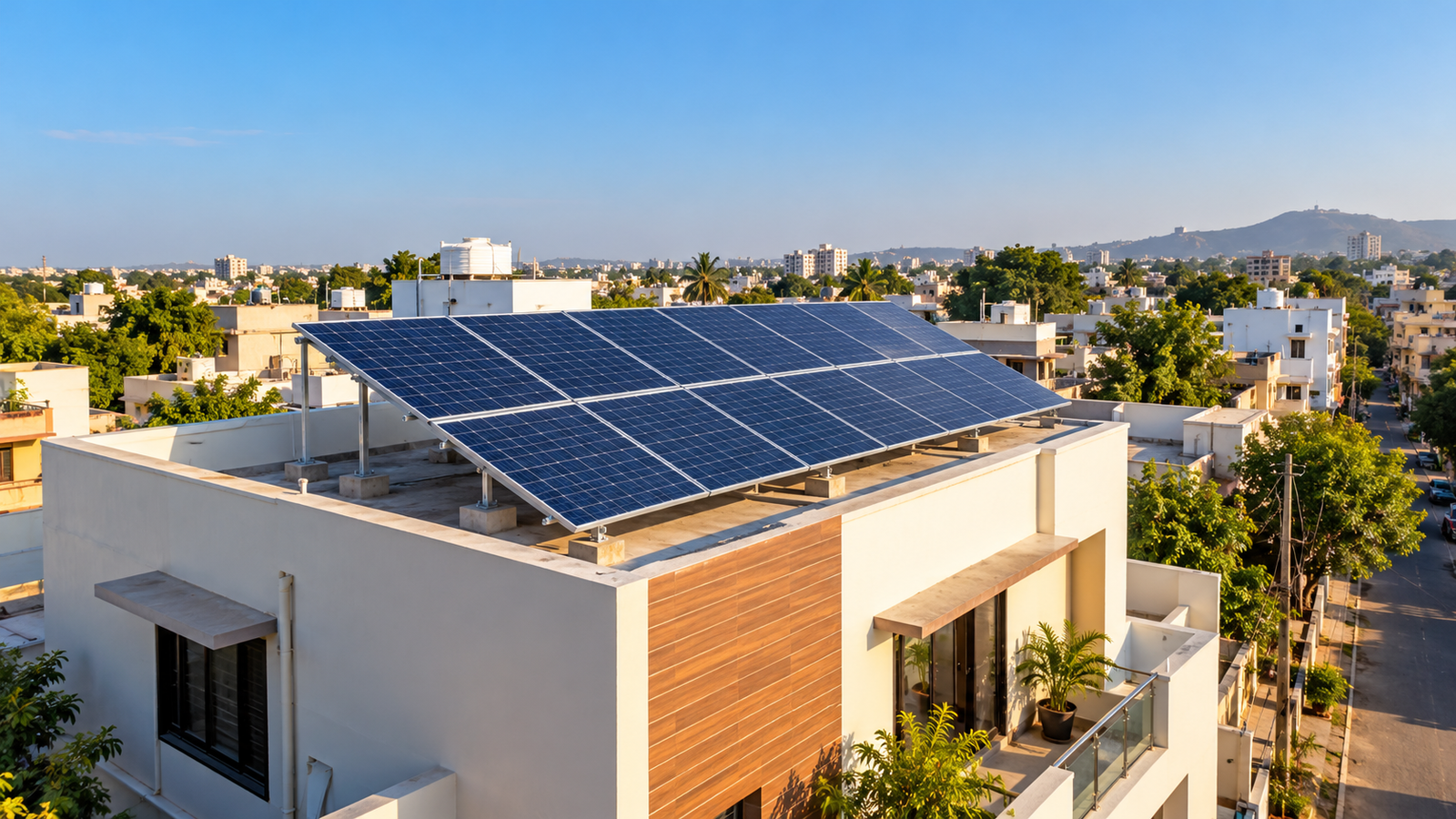
Your electricity bill after solar installation may not be zero because rooftop solar reduces the electricity you purchase from the grid, but it doesn’t eliminate every charge. Fixed charges usually remain, while electricity duties and other tariff-related charges may also apply. Your bill can also vary depending on electricity consumption, solar generation, seasonal changes, and your electricity distribution company (DISCOM)’s net-metering rules.
You installed rooftop solar expecting a zero bill. Then the bill from MSEDCL, PGVCL or Torrent Power arrived, and it wasn’t zero.
If you’re wondering why an electricity bill comes after solar, often nothing is wrong. Sometimes, though, the bill points to a real problem. For example, your electricity provider may not have activated net metering yet, or your solar system may generate less electricity than expected. Below are the eight common reasons, how to read your bill, and what to do next. Tariffs and net-metering rules differ between states and electricity distribution company (DISCOMs), so confirm the details for your own connection.
Key takeaways
- Solar reduces the units you buy from the grid. Fixed charges usually remain, and duties or other tariff charges may apply.
- A high bill soon after installation has several possible causes, including fixed charges, a billing period that overlaps the days before your system was running, previous dues carried forward, missing export credits, an estimated reading, higher usage or lower generation. Check your bill and inverter data before assuming one.
- Under net metering, energy charges are generally based on grid imports minus exports. Solar you use directly at home lowers your imports but doesn’t show up as export on the net meter.
- Monsoon, dust, shading, inverter shutdowns, power cuts and higher usage can all increase what you import.
- PM Surya Ghar helps homes pay for rooftop solar. The “free electricity” is what your own panels generate, so it doesn’t make a bill zero by itself.
8 Reasons Your Electricity Bill After Solar Installation Is Not Zero
1. Fixed Charges Still Apply After Solar Installation
Fixed charges after solar installation are one of the most common reasons a bill isn’t zero, and they’re normal. Solar reduces the energy you buy from the grid, but it usually doesn’t change charges linked to your connection.
A residential bill has three kinds of charges:
- Energy charges — Your electricity provider charges you for the units you use from the grid after applying eligible solar credits. Solar can reduce these significantly, and in some billing cycles to zero.
- Fixed charges — usually linked to your connection rather than your usage. Your electricity distribution company (DISCOM)’s tariff sets them, for example by connection category, phase (single or three-phase) or approved electricity load.
- Duties and adjustments — depending on your state and tariff, these can include electricity duty and per-unit adjustments, such as the fuel adjustment charge (FAC) in Maharashtra or the fuel and power purchase price adjustment (FPPPA) in Gujarat.
A bill made up mostly of fixed charges is often the realistic minimum for a grid-connected home. It’s a good sign, but to confirm your system is performing well, compare the generation in your inverter app with the expected figure for your system size.
Tip: If you switched to a three-phase connection or increased your approved electricity load during solar installation, your fixed charges may also change. Check your electricity distribution company’s (DISCOM) tariff schedule to understand how it calculates these charges.
2. Why Is My Electricity Bill High After Solar Installation?
A higher bill soon after installation can have several causes, so check before assuming one:
- The billing period overlaps installation. Your first bill may cover days or weeks before your system was running or before net metering started.
- Previous dues: Your electricity provider may add unpaid amounts, outstanding dues, or adjustments from earlier bills to your current electricity bill.
- Fixed and other charges still apply. They can make up a large share of the bill even when your net units are low (see reason 1).
- Export credits are missing. Before net metering starts, your electricity provider must install or configure a meter that records electricity flowing in both directions. The provider must also approve and activate your solar connection. Until then, your bill may not reflect the electricity you export to the grid. Incorrect meter readings or missing solar credits can also affect your bill.
- Your electricity provider replaced the meter during the billing cycle. Your electricity provider may combine readings from your old and new meters in one bill.
- Your electricity provider estimated the meter reading. If your electricity provider estimates your bill, the amount may not reflect your actual imports and exports.
- Usage or generation changed. Higher consumption, cloudy weather or a system fault (reasons 5 to 7) can also raise your imports.
How to check:
- Find the import, export, and net units on your electricity bill. Then check whether your electricity provider used actual meter readings or estimated your usage. Labels vary, so exports may appear under another name, such as units injected or net exports.
- Check the previous balance or arrears line for amounts carried over from earlier bills.
- Check the reading dates on your electricity bill. Then compare them with the dates your electricity provider approved and activated your solar system and installed your net meter.
- Note the import and export readings on your net meter’s display and compare them with the bill.
- Check your inverter app for generation over the same dates as the bill’s reading period.
- If the figures don’t match or exports seem to be missing, contact your installer and your electricity distribution company (DISCOM). Share copies of your bills, photos of the meter display and your generation data.
3. How Net Metering Affects Your Solar Electricity Bill
Net metering plays an important role in calculating your electricity bill after solar installation. A net meter records two numbers: units your home imports from the grid and units you export to it. When your home uses solar electricity directly, we call it self-consumption. It lowers your imports, but the net meter doesn’t record it. In Maharashtra, where your electricity distribution company (DISCOM) also reads a separate solar generation meter, that meter records it as part of total generation.
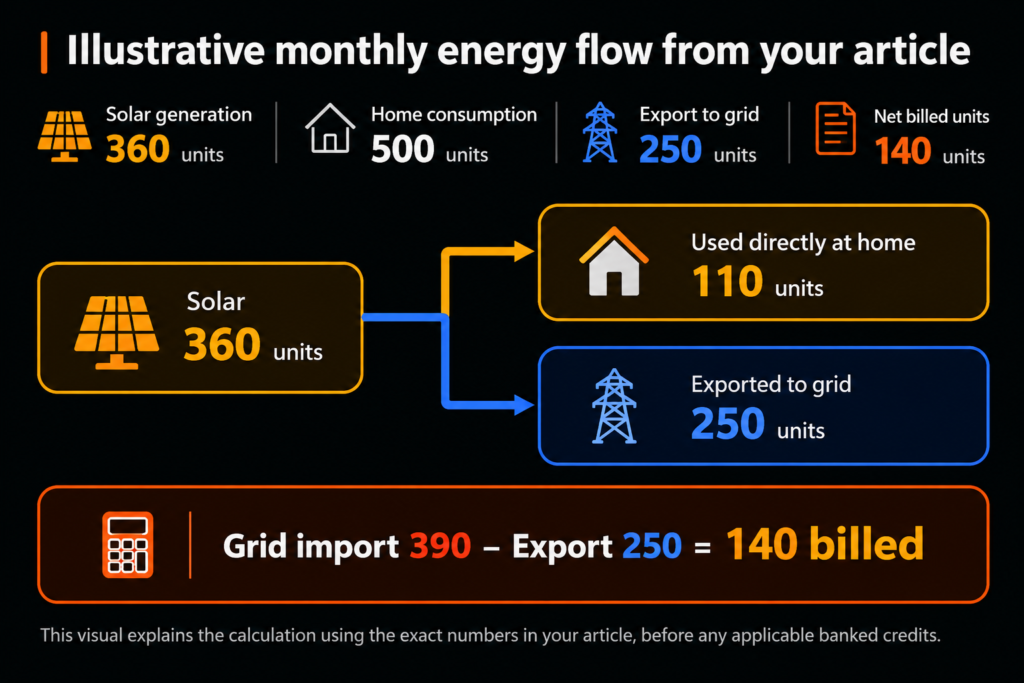
Here is how a solar net metering bill works, using an illustrative example for a 3 kW system in a month of average generation. It is not real customer data:
| Item | Units | What it means |
|---|---|---|
| Solar generation | 360 | Everything the panels produced (inverter app) |
| Solar electricity used directly at home | 110 | Solar used at home as it was generated; not recorded by the net meter |
| Exports to grid | 250 | Surplus solar sent to the grid (net meter export reading) |
| Electricity taken from the grid | 390 | Everything drawn from the grid, day and night (net meter import reading) |
| Total home consumption | 500 | Electricity taken from the grid plus solar electricity used directly at home |
| Units you are charged for | 140 | Electricity taken from the grid minus exports, before any unused solar units saved for a later bill |
How the numbers fit together:
- Generation splits into solar electricity used directly at home (110) and exports (250).
- The 250 exported units offset 250 of the 390 imported units, leaving 140 units you are charged for.
- Those 140 units equal the gap between what the home used (500) and what the panels produced (360).
In this example, energy charges would apply to 140 units, plus fixed charges and any other applicable charges. In Maharashtra, your electricity provider adjusts eligible credits from earlier months before calculating your bill.
What happens to surplus units? The rules differ by state:
- Maharashtra: if you export more than you import in a billing period, the extra units are carried forward to your next bill as credits. Credits still unused at the end of the financial year are bought by your distribution company at the Generic Tariff that MERC approves for that year. If that credit keeps growing for three financial years in a row, half is paid to you directly and half is credited to a later bill.
- Gujarat (PGVCL, the other GUVNL companies and Torrent Power): energy is settled every billing cycle, so surplus isn’t carried into the next cycle. For self-owned home systems, surplus is bought at ₹2.25 per unit for the first five years, and after that at 75% of the average tariff from recent GUVNL solar tenders. Systems officially approved and activated under earlier versions of the rules stay on those rules.
Because surplus is paid at these regulated rates, which are separate from your retail tariff, a system sized to your own consumption is usually the safer choice. Your electricity distribution company (DISCOM) can confirm the current rate for your system.
Does it matter when you use electricity? Under standard net metering, exports are generally offset against imports in units. In Maharashtra, if your connection is on a time-of-day (ToD) tariff, MERC’s rules first offset your usage in each time slot with exports from the same slot, and any extra exports are counted as off-peak. Your electricity distribution company (DISCOM) can tell you whether ToD applies to your connection.
4. An Undersized Solar System Can Increase Your Bill
As an approximate planning illustration, 1 kW of unshaded, well-oriented rooftop solar in Maharashtra or Gujarat might generate about 110–130 units a month, averaged over a year. Here is the arithmetic behind that range:
1 kW × 5 to 5.5 hours of full-sun equivalent a day × 30 days × 0.75 to 0.80 for real-world losses ≈ 110 to 130 units a month
The sun-hours and loss figures are typical assumptions, not measurements for your roof. Actual output depends on your location, roof direction and tilt, shading, panel temperature, equipment and dust. For a site-specific figure, ask your installer for a generation estimate or use NREL’s PVWatts calculator.
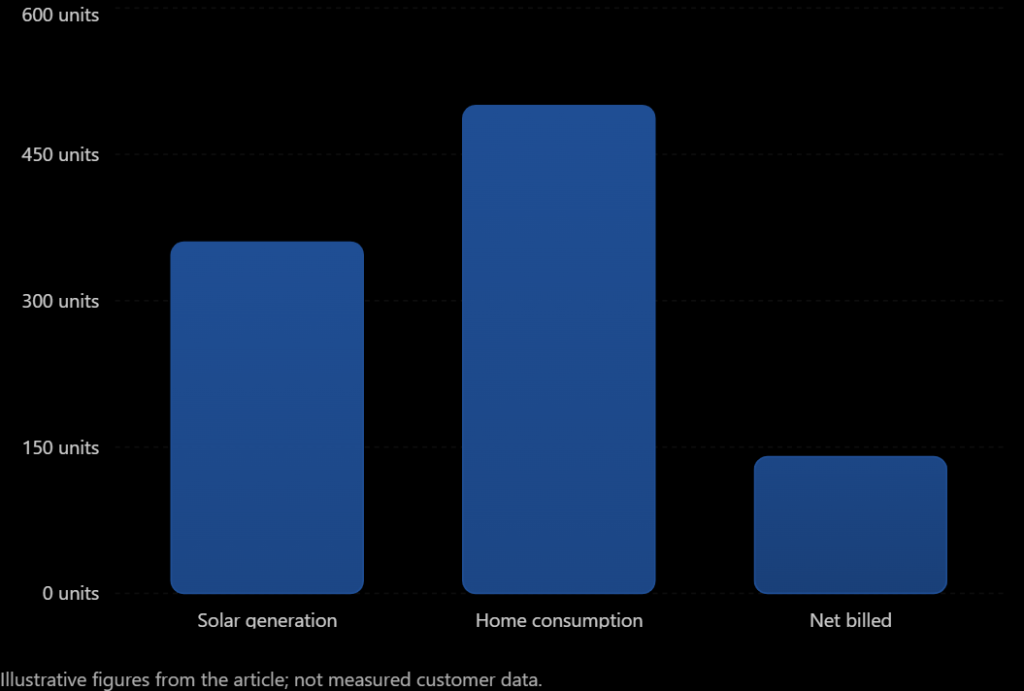
Using the same illustration, a 3 kW system might produce about 330–390 units a month. If your home uses 500 units, you would still import and pay for the difference, as the example in reason 3 shows. This can happen when you choose a smaller solar system because of limited roof space or your approved electricity load. Your electricity bill may also increase if your household uses more electricity after installation. To see what a correctly sized system could save, read our guide on how much you can save with rooftop solar.
5. Your consumption has gone up
Your electricity bill after solar installation may increase if your family starts using more electricity than before. They may add another AC, run cooling appliances for longer hours, charge an electric vehicle, use a new water heater, or have more family members living at home.
Compare your total consumption (import plus solar electricity used directly at home) with the same months last year, not imports alone. If consumption has risen, the bill reflects your new usage, not a fault.
6. Monsoon and winter reduce generation
Seasonal changes can affect your electricity bill after solar installation because solar panels generate different amounts of electricity throughout the year.
In Maharashtra, credits banked in sunny months can offset part of a monsoon shortfall within the same financial year. In Gujarat, your electricity provider settles surplus solar electricity according to the applicable billing rules. Where these rules require payment each billing cycle, the provider pays for eligible surplus units instead of carrying them forward to the monsoon season. Whether your bill balances out over the year depends on system size, usage and settlement rules. For more, see our guide on how solar performs during the monsoon in Gujarat and Maharashtra.
7. Dust, shading or an inverter fault
Your system may be producing less than it should without any obvious sign:
- Dust and dirt: dust, bird droppings and pollution cut output, especially in dry months and near roads, construction sites or industrial areas.
- Shading: a new building, water tank, tree or antenna can shade part of the array. In many system designs, shade on one panel also pulls down the output of the panels connected to it.
- Inverter shutdowns: inverters disconnect when grid voltage or frequency goes outside permitted limits. Frequent trips, for example where local voltage runs high, reduce generation. Report days with zero or unusually low generation to your installer.
Panel type and quality matter too; our guide to choosing the right solar panel technology explains the differences.
Bill still doesn’t add up? Contact your installer and your electricity distribution company (DISCOM) with your bills, meter readings and generation data.
8. Power cuts switch off on-grid solar
Most home systems are on-grid, and a standard on-grid inverter shuts down automatically when grid power fails, even on a sunny day. This safety feature, called anti-islanding protection, prevents the solar system from sending electricity into power lines during a grid outage. It helps protect maintenance workers.
Frequent daytime outages therefore mean lost generation. Hybrid systems with batteries, or off-grid systems, can keep selected loads running during an outage, depending on their design. For a full comparison, read our guide to on-grid vs off-grid solar systems.
PM Surya Ghar promised free electricity. Why do I still get a bill?
The PM Surya Ghar: Muft Bijli Yojana is a central government scheme that helps households pay for rooftop solar. When the Union Cabinet approved it in February 2024, the government said households would get 300 units of electricity free every month. Those free units are the ones your own panels generate.
The scheme supports the cost of installing the system; it doesn’t by itself make your bill zero. In practice:
- Your bill falls by the units your system actually generates, whether you use them at home or export them. Your solar system can generate around 300 units of electricity per month only if you choose the right system size and install the panels in a suitable location.
- Fixed charges usually remain, and duties or other tariff charges may apply.
- If your home uses more than your panels generate, or generation dips in the monsoon, you may still pay for net units.
As of 16 October 2026, the official portal lists a central subsidy of ₹30,000 per kW up to 2 kW and ₹18,000 per kW for the third kW, capped at ₹78,000, and says the scheme closes on 31 March 2027. It also suggests system sizes by monthly usage: 1–2 kW for up to 150 units, 2–3 kW for 150–300 units, and above 3 kW for more than 300 units.
Check the scheme’s current benefits and eligibility on the official PM Surya Ghar portal.
Net metering vs net billing: what’s the difference?
Net metering and net billing are separate arrangements, even though the names sound alike. Under net metering, exports are offset against imports in units. Under net billing, your electricity provider calculates the value of imports and exports separately in rupees. Which arrangement applies depends on your state’s regulations, your consumer category and your system, so confirm yours from your connection documents or with your electricity distribution company (DISCOM).
| Arrangement | How exported power is treated | What you are billed for |
|---|---|---|
| Net metering | Exported units offset imported units, unit for unit | Net units (import minus export), after any unused solar units saved for a later bill |
| Net billing (net feed-in) | Exported units are credited in rupees at a set rate, usually different from your retail tariff | All imported units at your tariff, minus the rupee credit for exports |
| Gross metering | All generation is exported and paid for at an agreed rate | All the units your home consumes, at your tariff |
These are general descriptions. How each arrangement is applied, and at what rates, depends on your state’s regulations and your electricity distribution company (DISCOM).
What can differ between MSEDCL, PGVCL and Torrent Power customers?
MERC in Maharashtra and GERC in Gujarat set the rooftop solar rules, and each electricity distribution company (DISCOM) applies them. A solar electricity bill in Maharashtra can therefore work differently from rooftop solar billing in Gujarat. Before comparing your bill with a neighbour’s or a relative’s, check these points:
| What can differ | Why it affects your bill |
|---|---|
| Fixed charge structure | Sets the minimum you pay each month |
| Billing cycle (monthly or bi-monthly) | Changes the period over which imports and exports are netted |
| Carry-forward and settlement of surplus | Maharashtra carries surplus forward within the financial year; Gujarat settles it every billing cycle (see reason 3) |
| Duties and per-unit adjustments (such as FAC or FPPPA) | Can apply even when your net units are low |
| Time-of-day (ToD) tariffs | Can change how imports and exports are valued by time slot |
| Limits on rooftop capacity | In Maharashtra, system capacity can’t exceed your approved electricity load; Gujarat’s rules allow home systems irrespective of approved electricity load, within the regulations’ capacity limits |
Your electricity distribution company (DISCOM)’s tariff order and net-metering guidelines are the final reference for your connection.
How to Read Your Electricity Bill After Solar Installation
To understand your electricity bill after solar installation, start by checking the net-metering details. A net-metered bill includes information that a regular electricity bill may not show. In Maharashtra, MERC’s rules require details such as solar generation, electricity consumption, net billed units, and banked units. In Gujarat, GERC’s rules specify details such as exported units, supplied units, net billed units, and net exports. Your electricity provider may use different labels, whether you receive your bill from MSEDCL, PGVCL, or Torrent Power. Look for the following details on your bill:
| Line on the bill | What it means | What to check |
|---|---|---|
| Import reading (current and previous) | Electricity taken from the grid: everything drawn from the grid this cycle | Compare with the same month before solar, allowing for changes in usage |
| Export reading (current and previous) | Units your system sent to the grid | Usually above zero once net metering is active and your system produces more than your home uses at the time |
| Net units | Units you are charged for: import minus export, before any unused solar units saved for a later bill | Should match the two readings above |
| Carried-forward or banked units | Surplus from earlier cycles; carried forward in Maharashtra, settled each cycle in Gujarat | Can rise in sunny months and fall in the monsoon |
| Fixed charges | Monthly charge for your connection | Usually present with or without solar |
| Energy charges | Charges on the units you’re billed for | Fall as your net units fall |
| Duties and other charges | Statutory duties and changes to electricity charges | Depend on your state and tariff |
Then compare with your inverter app, using the same dates as the bill’s meter-reading period rather than a calendar month. Over the same period, generation is normally higher than export, and the difference is roughly your solar electricity used directly at home. Small gaps can come from mismatched dates, app rounding or differences in how the meter and inverter record energy, so look for large or repeated gaps. If export looks far too low compared with generation, or the bill is marked average or estimated, go back to reason 2.
How to Reduce Your Electricity Bill After Installing Solar
Reducing your electricity bill after solar installation requires more than just installing solar panels. Regular system checks, proper maintenance, and smart electricity usage can help you get better results from your rooftop solar system.
- Compare a full year, not one month. Put 12 months of bills next to your inverter’s monthly generation. Solar is best judged across seasons.
- Keep panels clean. How often depends on local dust, rain and the manufacturer’s guidance; a drop in output on clear days is your signal. Clean when the panels are cool, with clean water and a soft brush. Never walk on the panels or touch cables or the inverter, and use a professional if your roof has no parapet or safe access.
- Check generation weekly. A quick look at your inverter app catches faults, trips and new shading early.
- Confirm net metering is active. Then check that each bill records your exports. In Maharashtra and Gujarat, the regulations require net-metered bills to show them.
- Cut waste at home. Inverter ACs, BLDC fans and LED lights reduce the units you need in the first place.
- Run heavy loads in sunny hours where practical. Washing machines, water pumps and EV charging during the day raise solar electricity used directly at home. Under unit-based net metering the saving may be small, but it can matter more under ToD tariffs or net billing.
- Review your system size if usage has grown. Adding capacity depends on roof space, electricity distribution company (DISCOM) approval and, in Maharashtra, your approved electricity load.
- Schedule periodic inspections. Have the wiring, earthing, connectors, mounting structure and inverter checked as your installer and the manufacturers recommend. Panel output also declines slowly over the years; your panel warranty explains by how much.
Frequently asked questions
Why is my electricity bill high after installing solar?
A high electricity bill after solar installation does not always mean your solar system has a problem. Several things can cause it: fixed charges, a first bill that covers days before the system was running, previous dues carried forward, missing export credits (for example if net metering isn’t active yet), a meter replaced mid-cycle, an estimated reading, higher household usage, seasonal dips in generation, or a system producing less than expected. Compare the bill’s dates, arrears and readings with your net meter display and inverter data to find which applies.
Why is the export reading zero on my bill?
Labels vary, so first check whether exports appear under another name, such as units injected or net exports. If your bill should show exports and doesn’t, possible reasons include a net meter that hasn’t been installed or configured, an account not yet updated for net-metered billing, an estimated reading, or a system that isn’t generating. Check your inverter app first, then compare the bill with your net meter’s display and contact your installer and electricity distribution company (DISCOM).
Why does my bill say “average” or “estimated” after solar?
It means the meter wasn’t read for that cycle, so the electricity distribution company (DISCOM) billed an estimate that may not reflect your exports. Photograph the meter’s import and export readings, send them to your electricity distribution company (DISCOM) and ask for a corrected bill.
What are solar import and export units?
Import units are the electricity your home draws from the grid. Export units are the surplus solar electricity your system sends to the grid. Under net metering, energy charges are generally based on import minus export, after any unused solar units saved for a later bill.
Can I get paid for extra solar units?
Yes, at regulated rates. In Maharashtra, surplus units carry forward as credits, and any left at the end of the financial year are bought at MERC’s Generic Tariff for that year. In Gujarat, surplus is settled every billing cycle; for self-owned home systems it’s bought at ₹2.25 per unit for the first five years, then at 75% of the average tariff from recent GUVNL solar tenders. Your electricity distribution company (DISCOM) can confirm the rate for your system.
How do I know if my solar system is underperforming?
Compare monthly generation in your inverter app with the expected figure for your system size and location, and with the same month last year. Days with zero output, sudden drops on clear days or frequent inverter errors mean it’s time to call your installer.
The bottom line
Your electricity bill after solar installation may not reach zero because fixed charges, seasonal changes, and higher household electricity usage can still affect the final amount.
The best protection is getting the basics right from the start: a system sized to your real consumption, a roof assessment for shading and direction, professional installation, and a clear explanation of how your electricity distribution company (DISCOM) bills net-metered homes. Our guide to choosing the right solar installation company covers what to look for.
Planning rooftop solar for your home?
Solar Smart Private Limited designs and installs residential rooftop solar in Maharashtra and Gujarat. Book a free solar site visit, and our team will look at your roof and electricity usage to help you choose the right system size.
Call 992 444 9988 or visit www.solarsmart.co.in.
Be Smart. Choose Solar Smart.
References
Official sources, accessed 16 October 2026:
- Maharashtra Electricity Regulatory Commission, MERC (Grid Interactive Rooftop Renewable Energy Generating Systems) Regulations, 2019, dated 30 December 2019
- Maharashtra Electricity Regulatory Commission, MERC (Grid Interactive Rooftop Renewable Energy Generating System) (First Amendment) Regulations, 2023, Maharashtra Government Gazette, 16 November 2023
- Maharashtra Electricity Regulatory Commission, MERC (Grid Interactive Rooftop Renewable Energy Generating Systems) (Second Amendment) Regulations, 2024, Maharashtra Government Gazette, 29 August 2024
- Gujarat Electricity Regulatory Commission, GERC (Net Metering Rooftop Solar PV Grid Interactive Systems) Regulations, 2016, Notification No. 5 of 2016, 17 June 2016, with amendments dated 5 October 2017, 22 January 2020, 31 May 2022, 6 September 2024 and 3 November 2025
- Ministry of New and Renewable Energy, PM Surya Ghar: Muft Bijli Yojana national portal
- Press Information Bureau (Ministry of New and Renewable Energy), Cabinet approves PM-Surya Ghar: Muft Bijli Yojana for installing rooftop solar in One Crore households, 29 February 2024